An asphalt driveway is one of the most visible and frequently used surfaces on any residential or commercial property. In Orange County, where the climate delivers intense sunlight year-round, occasional winter rains, and significant temperature swings between seasons, asphalt driveways face a demanding combination of environmental stresses. Driveway Sealcoating Orange County is the most effective and widely recommended maintenance strategy for protecting asphalt surfaces against these forces and extending pavement life for years.
This guide explains what sealcoating is, how it works, what the application process involves, and why regular sealing is an essential part of responsible driveway maintenance in Southern California.
What Is Driveway Sealcoating?
Sealcoating is the process of applying a thin, protective liquid coating over the surface of an asphalt driveway. The sealant is typically composed of asphalt emulsion, water, mineral fillers, and proprietary additives that together form a durable, flexible barrier when cured. This barrier sits on top of and within the surface pores of the asphalt, sealing out the damaging agents that cause asphalt to degrade over time.
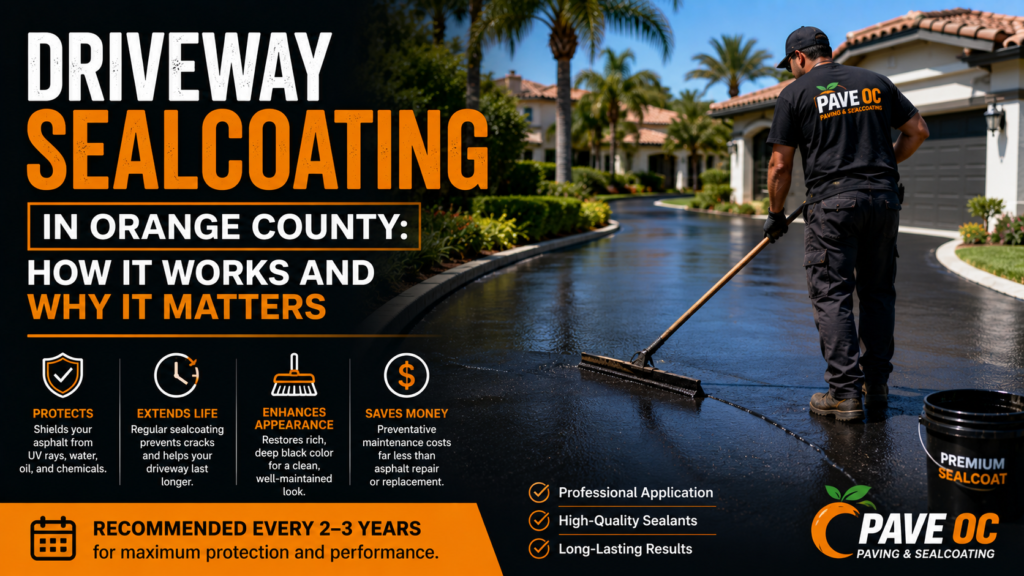
A properly applied sealcoat gives a driveway a rich, deep black finish that closely resembles freshly laid asphalt. Beyond aesthetics, the coating performs a critical protective function that is not visible to the naked eye it slows oxidation, resists moisture penetration, deflects UV radiation, and creates a surface that repels oil, gas, and chemical spills.
Why Asphalt Driveways Need Protection
Asphalt is an engineered composite material made from aggregate sand, gravel, and crushed stone bound together by bitumen, a petroleum-derived binder. It is this bitumen that gives asphalt its characteristic dark color, its flexibility, and its ability to withstand traffic loads. However, bitumen is susceptible to degradation from several environmental forces that are particularly intense in Orange County.
Ultraviolet radiation from the sun is perhaps the most significant enemy of unprotected asphalt. UV rays break down the chemical bonds in bitumen, causing the surface to oxidize. As oxidation progresses, the asphalt loses its flexibility and becomes brittle. Brittle asphalt cracks under the thermal expansion and contraction caused by temperature changes, and these cracks allow water to infiltrate the pavement structure.
Water is the other primary driver of asphalt deterioration. When moisture penetrates through cracks or surface pores, it reaches the base and subgrade layers beneath the pavement. In Orange County, the freeze-thaw cycle is less severe than in northern climates, but winter rains can still saturate the base, softening it and reducing its load-bearing capacity. Over time, water damage leads to potholes, base failures, and widespread surface deterioration that is expensive to repair.
Oil and chemical spills from parked vehicles also pose a threat. Petroleum-based fluids are chemically similar to the bitumen binder in asphalt, and when they penetrate the surface, they soften and break down the material, creating soft spots and accelerating deterioration.
How Sealcoating Protects Your Driveway
Sealcoating addresses each of these threats through a single, relatively simple application process. The sealed surface creates a continuous, impermeable barrier that prevents water from penetrating the asphalt. It reflects and absorbs UV radiation before it can reach the asphalt binder, dramatically slowing the rate of oxidation. The non-porous surface also prevents oil and chemical spills from soaking into the pavement, and makes cleaning spills far easier.
Research and field experience consistently show that sealed asphalt driveways outlast unsealed driveways by a significant margin. While an unsealed asphalt driveway typically lasts 10 to 15 years before requiring major repairs or replacement, a properly maintained, regularly sealed driveway can last 20 to 30 years. Sealcoating also maintains the flexibility of the asphalt, allowing it to better absorb the stress of vehicle loads without developing cracks.
The Driveway Sealcoating Process
Professional sealcoating involves more than simply painting a liquid onto a driveway surface. A proper application follows a structured process designed to ensure maximum adhesion, uniform coverage, and long-lasting protection.
Surface Cleaning and Preparation
Thorough surface preparation is the foundation of a quality sealcoating job. The driveway must be completely free of dirt, debris, vegetation, oil stains, and loose material before the sealant is applied. Crews typically begin by blowing or sweeping the surface to remove loose material, followed by pressure washing or scrubbing to eliminate embedded dirt and biological growth such as moss or mildew. Oil stains receive special attention degreasing agents are applied to break down petroleum residues, because sealant will not bond properly over oil-contaminated surfaces and will bubble and peel if applied over untreated stains.
Crack Filling
Existing cracks must be filled before the sealcoat is applied. Crack filler typically a rubberized or polymer-modified material is worked into the cracks to create a flexible, water-resistant seal that prevents moisture from entering the pavement. Crack filling is not a cosmetic step; it is a structural one. Unfilled cracks allow water to work beneath the sealcoat, undermining the protective barrier from below.
Sealcoat Application
Once the surface is clean and crack repairs have cured, the sealcoating material is applied in thin, even coats using squeegees, brushes, or mechanical sprayers. Professional contractors typically apply two coats for consistent coverage and adequate film thickness. Each coat must be applied evenly and allowed to partially cure before the second coat is added. The edges of the driveway are carefully detailed to prevent the sealant from running onto adjacent surfaces.
Curing and Drying
After application, the sealcoat requires time to dry and cure properly. The surface should be kept free of vehicle and foot traffic for at least 24 to 48 hours following application. Full curing, during which the sealant reaches its maximum hardness and protective performance, may take several days depending on ambient temperature and humidity. In Orange County’s warm climate, curing conditions are typically favorable for much of the year, though extremely hot days can cause the material to dry too quickly if not managed properly.
Types of Sealcoating Materials
Several sealcoating formulations are used in the industry, each with specific characteristics suited to different applications and conditions.
- Asphalt Emulsion Sealers: Water-based sealers made from refined asphalt. They are lower in volatile organic compounds and are a preferred choice for environmentally conscious projects. Asphalt emulsion sealers provide good protection and adhesion on most residential driveways.
- Coal Tar Sealers: Historically one of the most durable and water-resistant sealcoating materials, coal tar sealers offer strong protection against oil and chemical penetration. However, environmental concerns related to polycyclic aromatic hydrocarbons have restricted their use in some jurisdictions.
- Acrylic Sealers: Water-based acrylic formulations provide excellent UV resistance and color retention. They are often used on concrete driveways and decorative pavements, and offer good performance in high-UV environments like Orange County.
- Fast-Drying Sealers: Formulated to cure more quickly than standard products, these sealers are useful when a driveway needs to be returned to service within a short time window.
When to Sealcoat Your Driveway
For newly installed asphalt driveways, the general recommendation is to wait at least 90 days before applying the first sealcoat. Freshly laid asphalt needs time to fully cure and outgas the lighter oils in the mix. Applying sealcoat too soon can trap gases and interfere with the curing process.
After the initial sealing, most asphalt driveways in Orange County benefit from re-sealing every two to three years under normal conditions. Driveways that receive heavy vehicle traffic, exposure to chemicals, or significant solar exposure may benefit from more frequent applications. The most reliable indicator that it is time to reseal is the color and texture of the driveway surface. When the rich black color fades to gray and water no longer beads on the surface instead soaking in the protective coating has worn down and a new application is warranted.
Signs That Your Driveway Needs Sealcoating
Property owners in Orange County should watch for the following indicators that sealcoating is overdue:
- Fading or grayish color where the surface has oxidized
- Small surface cracks beginning to appear
- Rough or sandy texture as the binder degrades
- Water soaking into the surface rather than beading up
- Visible oil stains that have penetrated the surface
- Increased difficulty cleaning the driveway surface
Addressing these signs early before they progress to larger cracks, potholes, or base damage is the most cost-effective approach to driveway maintenance. The cost of sealcoating is a fraction of the cost of resurfacing or replacing a damaged driveway.
The Long-Term Value of Regular Sealcoating
Consistent sealcoating over the life of an asphalt driveway delivers compounding benefits. Each application renews the protective barrier, slows oxidation, and keeps the asphalt flexible and resistant to cracking. Properties with well-maintained driveways also enjoy enhanced curb appeal a fresh, black sealed driveway projects a clean, professional image that adds to the overall presentation of any home or business.
For Orange County property owners who want to protect their paving investment against the region’s demanding climate, regular sealcoating is not optional maintenance it is the single most effective preventive measure available.
Conclusion
Driveway sealcoating in Orange County is a science-based maintenance process that protects asphalt surfaces from UV damage, water infiltration, chemical spills, and the cumulative effects of daily traffic. By understanding what sealcoating is, why it works, and when it is needed, property owners can make informed decisions that preserve the value and longevity of their pavement investment. A well-sealed driveway in Orange County is not just an aesthetic asset it is a structurally sound, long-lasting surface that serves its purpose reliably for decades.